The Mitigation…
The email came in on a Tuesday.
We had submitted a permit for a garden fence — the modest, ordinary kind of paperwork you file when you're trying to keep deer out of an orchard. We expected it to be processed without incident. Instead, an Island County reviewer wrote back to tell us the permit had been canceled. Pulled aerial imagery. Noticed a change in our canopy. Wanted to know how many trees had been removed, and on what authority.
I read the email twice. Alex read it three times. Then we sat at the kitchen table and tried to figure out what we had just learned.
What we had just learned, it turned out, was that the line on our survey did not match the line in the county's records.
We had hired a certified arborist in February. We had walked the property with him. He had identified trees that were dying, leaning, or sitting where future structures would have to go. He had assured us, more than once, that the work he was proposing did not require a permit — the trees in question were, by his read of the survey, outside the shoreline district. The shoreline district is the county's protected zone along the high water mark. Inside it, you don't take down a single tree without paperwork. Outside it, you have ordinary discretion.
We had believed him. We had no reason not to. He was certified. He had done this kind of work for decades. The survey said what the survey said.
The county's records said something else.
There is a particular feeling that comes with discovering you have been wrong without meaning to be. It is not guilt, exactly. We had not been negligent. We had not cut corners. We had hired the right person, asked the right questions, followed the advice we had paid for. The trees that had come down were trees that needed to come down — damaged, dying, or in the way of structures we had every right to build. We had been careful with the bluff. We had protected the salal. We had been trying, the entire time, to be good stewards of this land.
And we had been wrong anyway.
The feeling is closer to vertigo. The ground you thought you were standing on turns out to be slightly different ground. The map you had been reading was not the map that mattered. There is no one to be angry at — not really — because everyone in the chain had been doing their job. The arborist had read the survey he was given. The surveyor had drawn the line as he understood it. We had trusted the people we were supposed to trust. The county was simply doing what the county does, which is enforce the version of the line they keep on file.
We waited a long week for them to come walk the land.
When they did, we watched them carefully. They measured. They counted. They looked at the canopy and at the ground and at the bluff and at the area in question. And then — we both noticed it — there was a moment that felt like a collective sigh. A small, almost involuntary recalibration. The aerial imagery had suggested something dramatic. The reality on the ground was modest. We had not clear-cut. We had not denuded a hillside. A handful of unsafe trees had come out, and the property was otherwise intact.
We were nervous the whole time. We had read about cases that ended badly. We had imagined fines, lawsuits, having to undo work that couldn't be undone. What we got, instead, was a reasonable conversation with reasonable people who could see, plainly, that we had been trying to do the right thing.
They asked us to file a retroactive permit for the tree removal. They asked us to submit a mitigation planting plan, designed to a 1:1 ratio of replacement vegetation across the impacted area. They told us what they needed, by when, and at what standard. And then they got in their truck and drove back to town.
Here is the part of the story we did not expect.
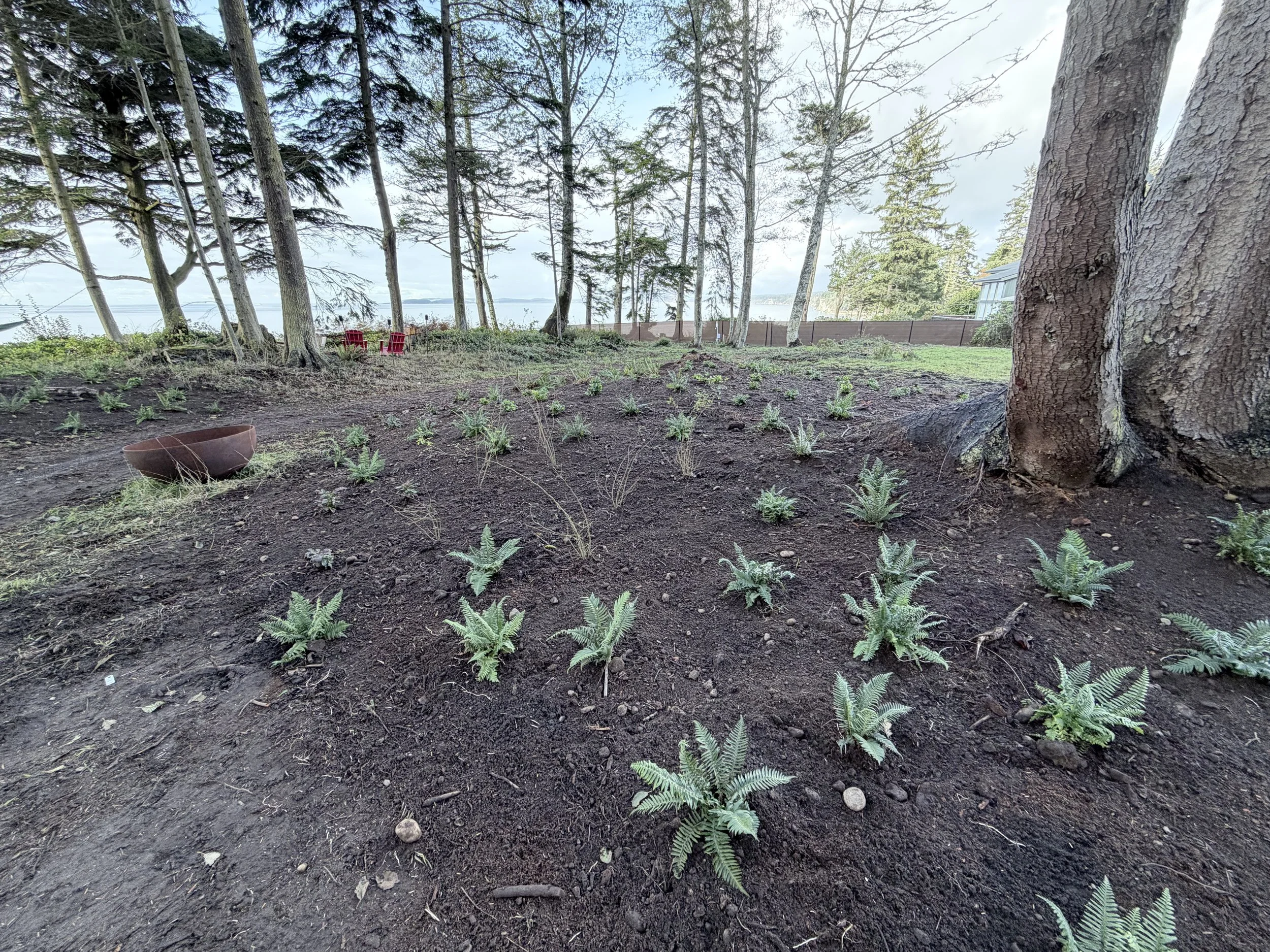
The mitigation plan was good news. We would have done some version of this anyway. We had already been talking about restoring the understory in places, planting natives, supporting the salal that holds the cliff together. The county had simply made the planting formal — and faster. They gave us a deadline, a ratio, and a standard. We hired a wetlands consultant to help draft the plan. We chose the species. We ordered the plants.
We planted over two hundred of them across roughly two thousand square feet. Native species, every one — the kinds of plants that belong here, that the deer will mostly leave alone, that will weave themselves into the existing canopy over years rather than seasons. The cost was meaningful: close to twenty thousand dollars by the time the consultant, the plants, and the labor were tallied. Not catastrophic. Not nothing.
We submitted the plan. They approved it. We planted. They came back to inspect. The fence permit was reissued.
And the trees we put in are, even now, doing what young plants do — quietly, slowly, almost imperceptibly becoming the canopy that the aerial photo will eventually show as healed.
A few things we'd say if you were sitting at our kitchen table and about to do something similar:
The line on your survey is a starting point, not a verdict. Different parties hold different versions of the line. Before you do anything irreversible, have the county confirm critical area boundaries directly. Ask in writing. Get the answer in writing.
Aerial imagery sees everything. Compliance is not a small-town handshake business anymore. Any change in canopy is visible, and if it raises a question, someone will ask it. This is not a bad thing. It is the system working.
Hire the certified person, but also do the second layer of homework. Even the right professional can read the wrong map. The expert is your first line, not your last.
If something goes wrong, show up. Walk the land with the county. Answer their questions plainly. Don't argue the boundary; ask what they need. Reasonable people respond to reasonable people.
Mitigation isn't punishment. It's accountancy. The land lost a thing; the land must be repaid in kind. The county is just the bookkeeper. And in our case, what we owed turned out to be exactly what we had wanted to give.
We are not quite in a position, yet, to be glad this happened. The week we waited for the inspection was a hard week, and twenty thousand dollars is twenty thousand dollars. But we are, increasingly, in a position to be glad about what it taught us. You can do everything right and still need to fix something. What matters is how you show up to fix it.
The plants are taking. The cliff is held. The fence is permitted. The canopy is on its way back.
Sometimes the land asks you to put something back. We did. We will again, every season, as long as we are here.